


- “Codex, grab the last plan Claude Code made and implement it.”
- “What’s the team building today?”
- “What is Alex working on in Codex right now?”
Features
How it works
- Start the daemon. It captures all your agents’ context in realtime.
- Add the MCP server. Any agent gets full awareness of every other agent.
- That’s it. Ask questions, continue sessions, fork — your context is everywhere.
Why Context Matters
As LLMs take over as the new operating system, managing AI context becomes more and more valuable. Context is the RAM — it’s everything LLMs can see. That’s the last interface between humans and AI. It’s the lowest level of abstraction we can get to.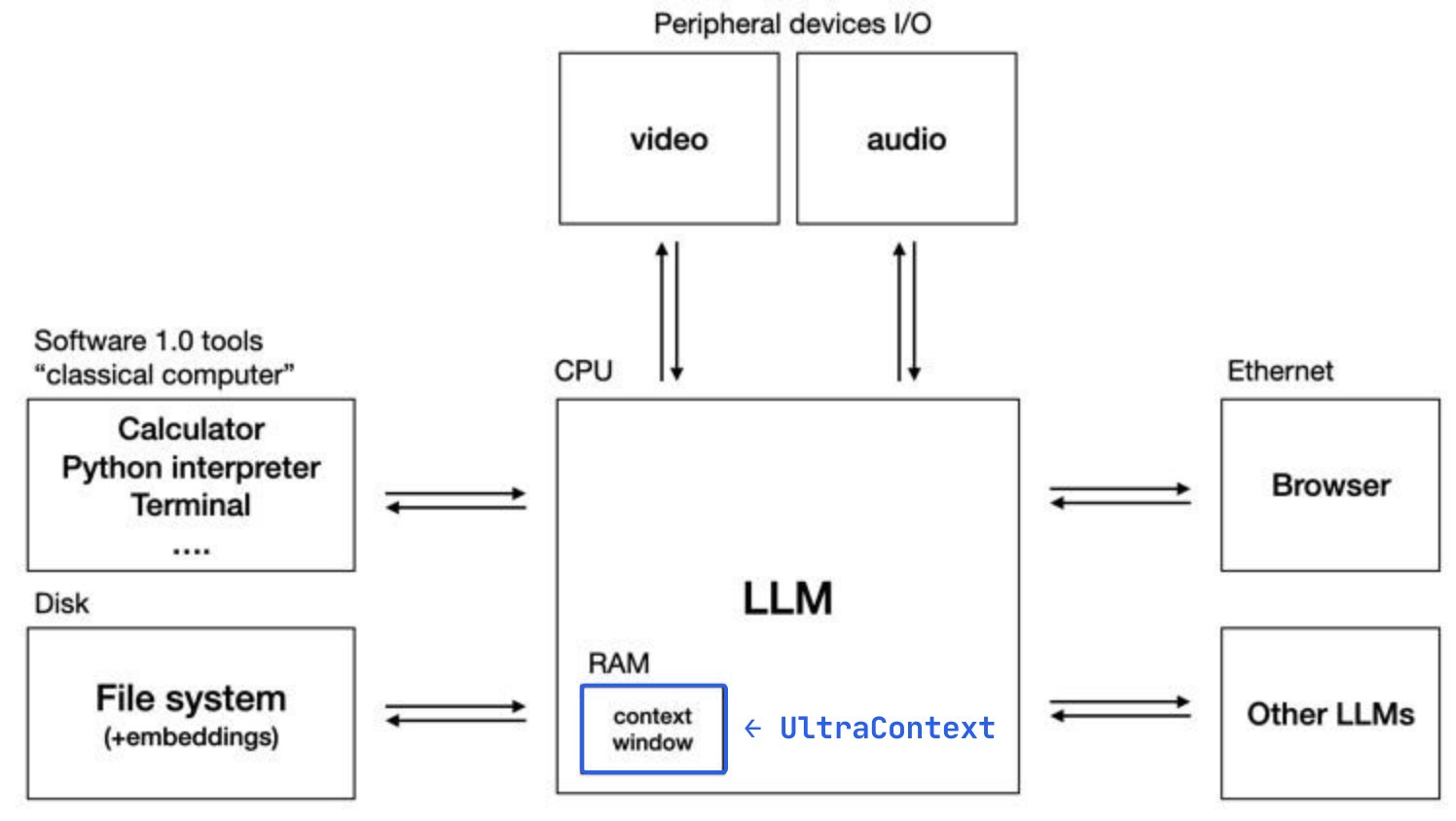
Source: Andrej Karpathy (adapted)
Context engineering techniques
Context engineering techniques
Compaction — Reversible reduction. Strip info that can be reconstructed from external state. File write? Drop content, keep path. Search? Drop results, keep query. No information lost, just externalized.Summarization — Irreversible reduction. Use only when compaction gains are tiny. Key trick: use structured schemas (fields to fill), not freeform prompts. Keep last few tool calls in full detail so the model knows where it left off.Offloading — Move context outside the window. Dump to files, retrieve on demand via path or ID. Even pre-summary context can be saved as a log file — models can grep it later if needed.Isolation — Two patterns:
- By communicating: Subagent gets only an instruction, returns only a result. Use for clear, bounded tasks.
- By sharing context: Subagent sees full history but has its own system prompt. Use when tasks need prior context. Trade-off: larger pre-fill, no KV cache reuse.
The internet before HTTP was a mess of incompatible protocols. Information was spread all over the place. Growth only exploded once we standardized the basic interface layer.We’re at that exact moment with AI.
Context API
For builders who want to go deeper. Git-like primitives for context engineering.
Just plug & play.
How it works
A single idea is all you need. The Context API consists of Contexts holding Messages. That’s it. Simple yet insanely powerful. Let’s dive in.Only updates and deletes generate new versions. Appends do not because you can time travel by index. See the View Context
History guide for more.
Contexts
Contexts are just containers. They can hold any collection of data you want. Conversation threads, user preferences, notes, etc. You name it.Messages
Messages are the building blocks of a context. They’re schema-free JSON objects, so you define the shape. Append, update, and delete with a single API call.metadata and index keys are reserved for internal use.
Quick links
Quickstart
Get running in 2 minutes.
Guides
Practical patterns for common use cases.
CLI
Sync agent sessions automatically.
MCP Server
Share context between agents.